
Why I Journal
It all started with Ramona Quimby

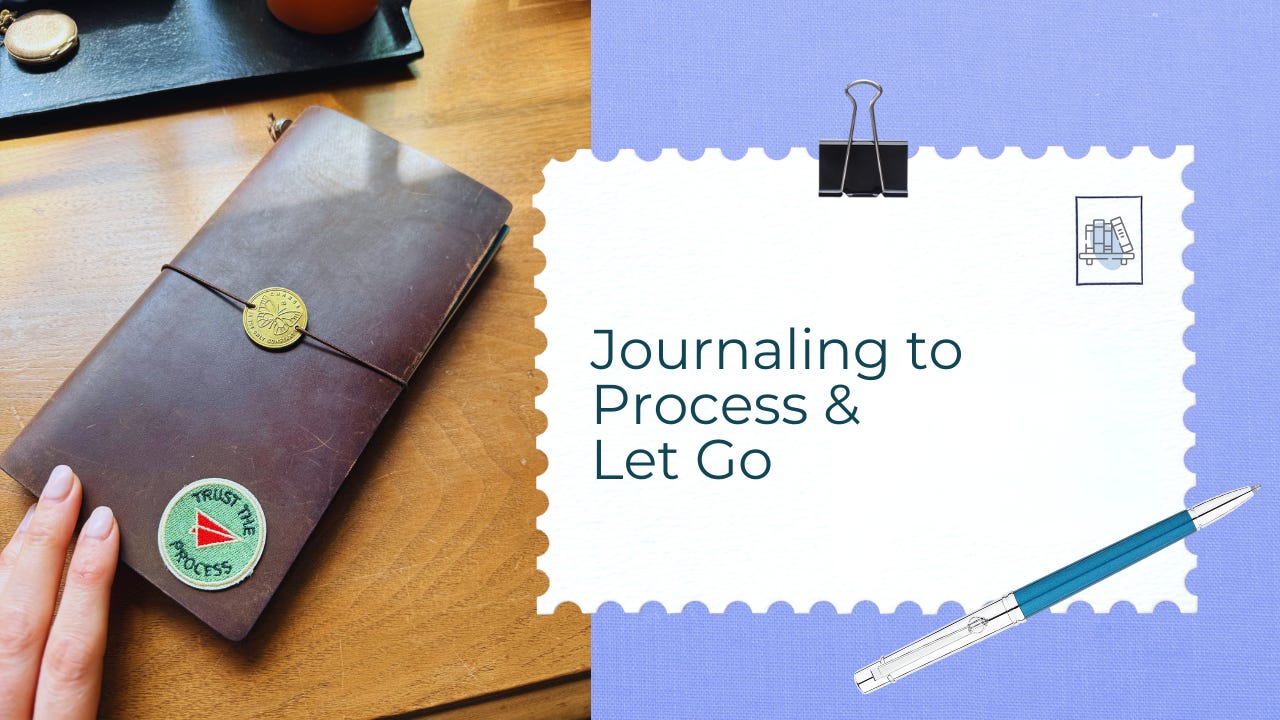
I got my first journal shortly after I learned to write. It was Christmas 1986, and Grandma Ruth gave me a spiral-bound notebook with Ramona Quimby on the cover. Grandma always wrote little inscriptions inside the books she gave as gifts, and on the inside cover, she wrote: A place for all your marvelous thoughts!
Holy shit, the feeling of it. The small, private thrill of having somewhere to put my thoughts. My thoughts were not only marvelous but worthy of being documented. I wrote in blocky pencil print about my friends and my favorite day of the week (Wednesday, because we had art after recess and Italian Dunkers for lunch). I wrote poems and drew unicorns. My little kid brain was unleashed, and I filled that notebook right up.
One journal became two, then ten, then dozens. Spiral notebooks. Cloth-bound journals. Something with a lock and key at one point, because of course there was. I carried them through childhood, to college, and every apartment, through every version of myself that followed. For a long time, they came with me like proof of life.
There’s no wrong way to journal
There isn’t just one way to keep a journal. Those of us who put pen to paper come to the page for different reasons, and we all do it our own way.
Some people are archivists. They record what happened: what they did, what they ate, who they saw. The details matter. The date matters. Maybe they create beautiful pages layered with stickers, ticket stubs, and little bits of ephemera collected along the way. There’s something deeply grounding about capturing a life as it unfolds.
Other people use a journal as an emotional release valve. The things you can’t say out loud, the things that feel too sharp or messy or too much - all of that goes into the pages. The journal doesn’t interrupt. It doesn’t correct you. It simply holds the moment until you’re ready to turn the page.
Lots of people journal about their hobbies. Think reading journals, garden logs, travel notebooks, food diaries. This kind of journaling feels less about processing and more about documenting your love for…well, whatever it is you love.
And then there are the meaning-makers. The ones who aren’t necessarily recording what happened, but are trying to understand why, and now what. This is where I land.
The page as interior monologue
I write about the small things. Something someone said that lodged itself under my skin. A mood I can’t quite shake. An ordinary moment that somehow feels heavier than it should. And I write about the big things, too. Joy. Grief. Life transitions. The questions that don’t come with neat answers.
The goal isn’t to capture any of it perfectly, and it’s not to create some artifact I’ll revisit later. It’s to get the thoughts out of my head and onto the page, where they suddenly become more manageable. Once the words are there, the edges soften. The noise quiets. What felt tangled begins to unwind. And then I move on.
I don’t reread my journals. Not last week’s entry, not last year’s, not the ones from decades ago. I know for some people that’s the whole point, but it’s never really been true for me. The value has always been in the act itself, not in preserving the evidence.
Which brings me to the boxes.
Forty years of proof
I kept forty years of journals, starting with that first Ramona notebook. Every version of me was documented in ink. Every hope, every confusion, every heartbreak, every ordinary Tuesday. I lugged them around in cardboard boxes, then plastic bins. They came with me to college, my first apartment, and into my marriage with Dan. For the past 11 years, they’ve been stacked on a high shelf in my office closet. I gave my friend Stephanie strict instructions to burn them upon my demise because the thought of anyone reading them is just…no. Absolutely not. Which begged the question: Why was I holding on to these journals?
The truth is that, for a long time, I needed those journals as proof that I existed. Proof that what I felt was real. That my experiences mattered. That I had something to say, even if no one else ever read a word of it. There were years when I didn’t feel especially visible in my own life. Years when the page felt like the only witness. The journals quietly reassured me: You were here. This happened. You felt this.
Letting go
Over the past year, something shifted. I’d open the office closet, glance at the journals, and think: I should get rid of those. At first, the thought startled me. Could I really throw them away? Was that even allowed?? But once the idea surfaced, I couldn’t quite shake it. I sat with the question for weeks, trying to understand why now.
The answer was simple and kind of great. I don’t need proof of my life to trust that I’m living it. I don’t need to hold onto every former version of myself to know she existed.
So one crisp morning this March, I got on a step stool, pulled every journal down, flipped through a few pages, and placed them into three large garbage bags. Then I carried them outside and gently set them in the trash. (More gently than I usually handle trash, anyway.)
I know this will horrify some people, and I understand that completely. But I journal to process. And once something has been processed, I don’t need to keep carrying it. I can turn the page and start anew.
Let me know: Are you a journal-keeper? If so, tell me what you write about and (very important!) what the cover of your journal looks like.
